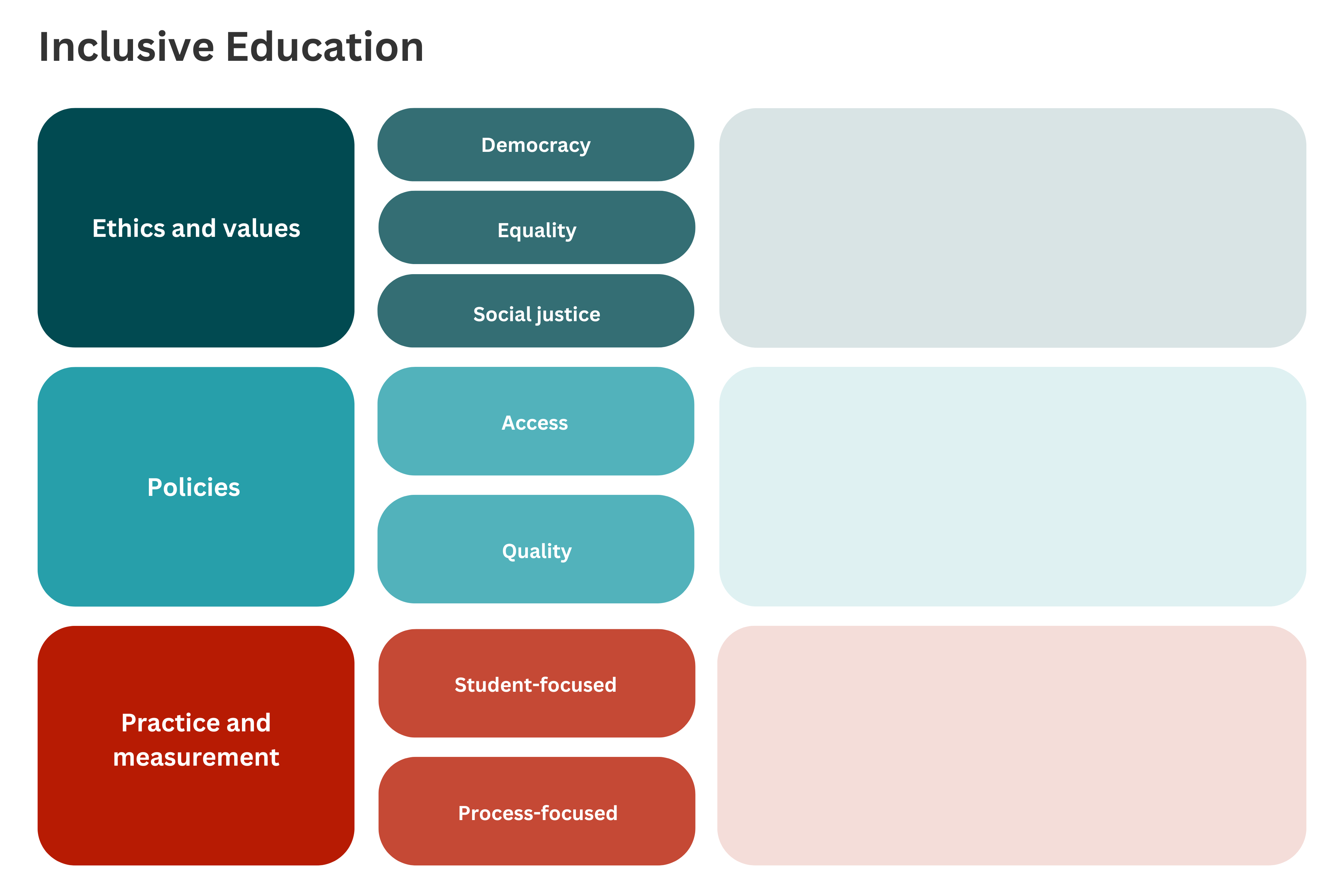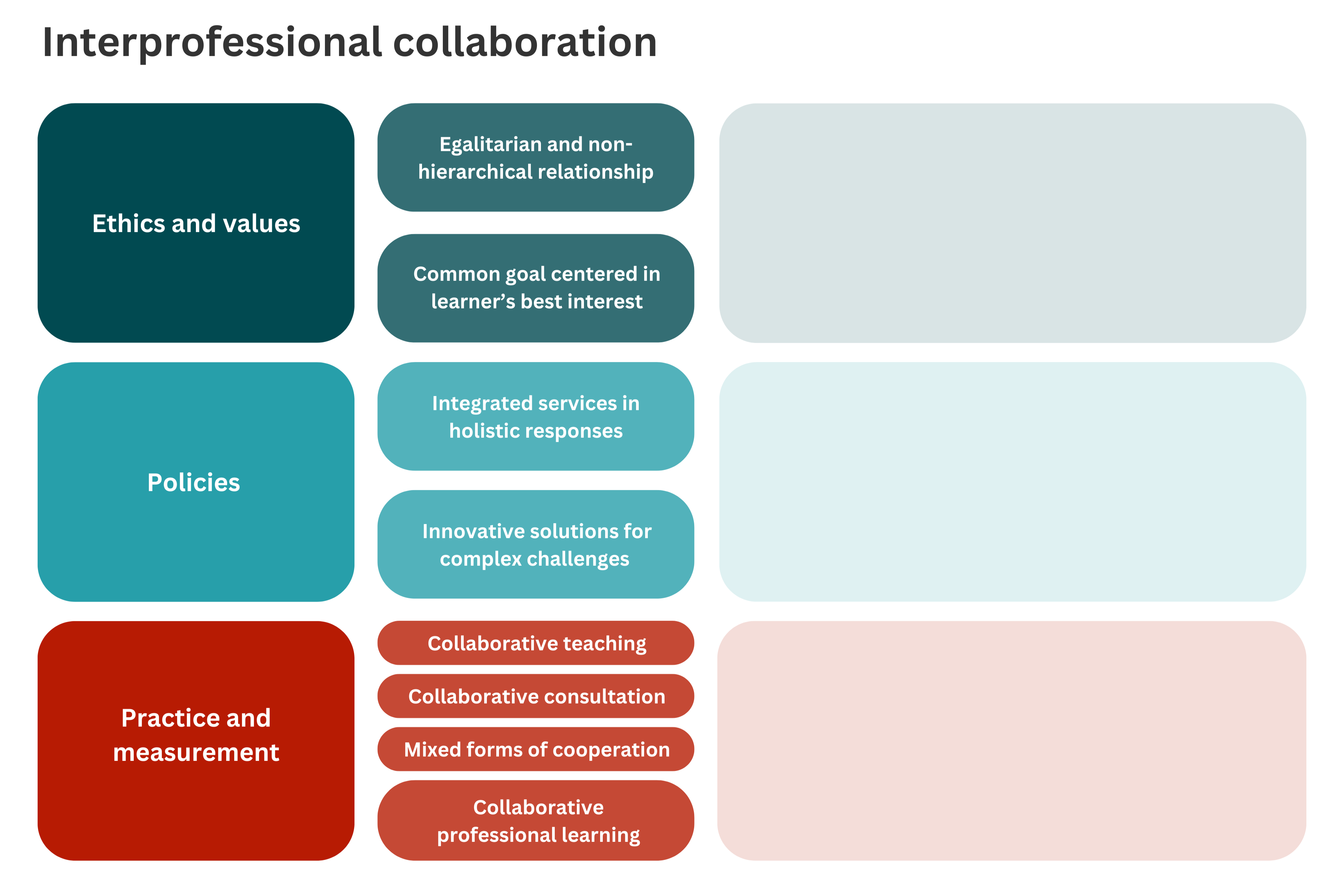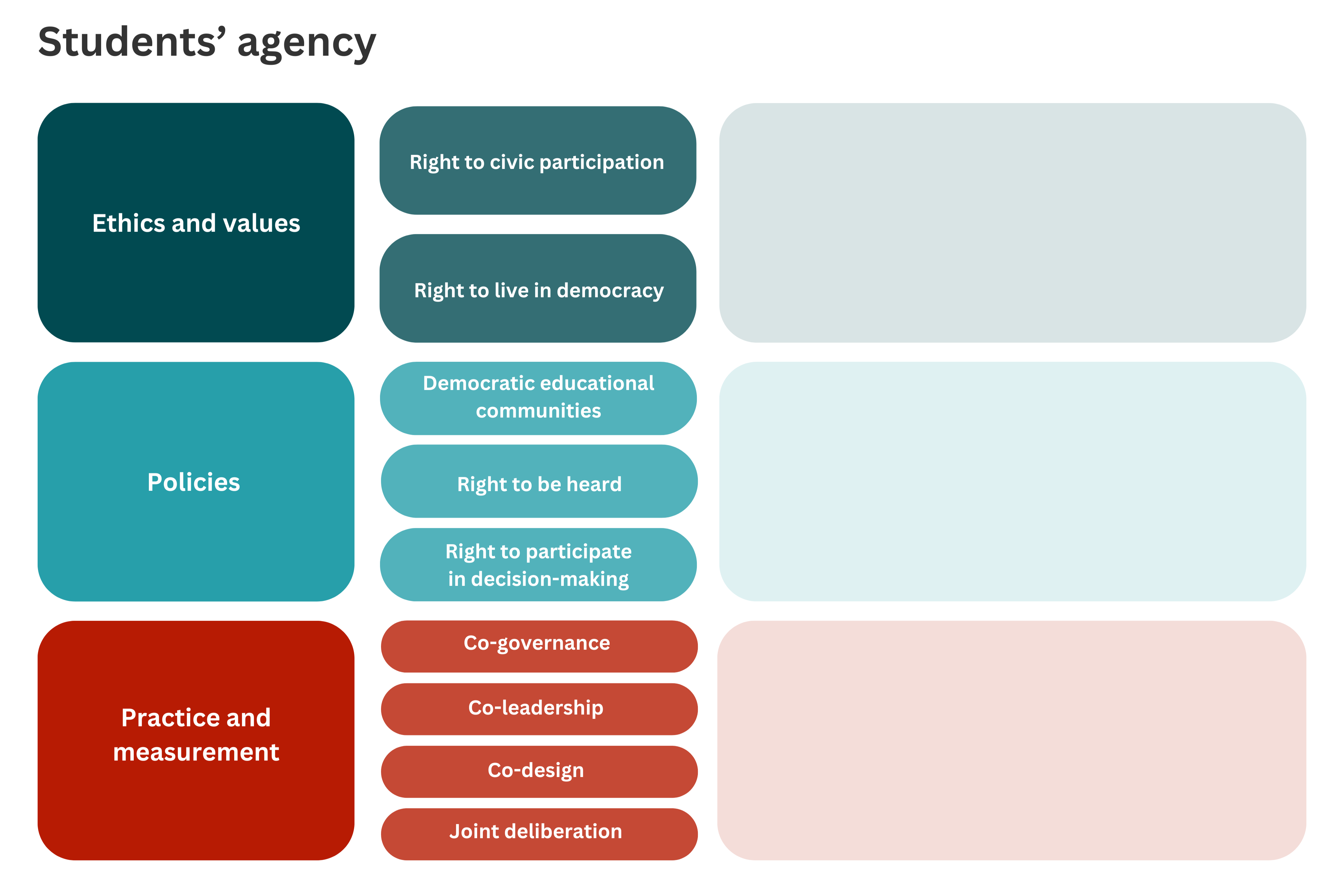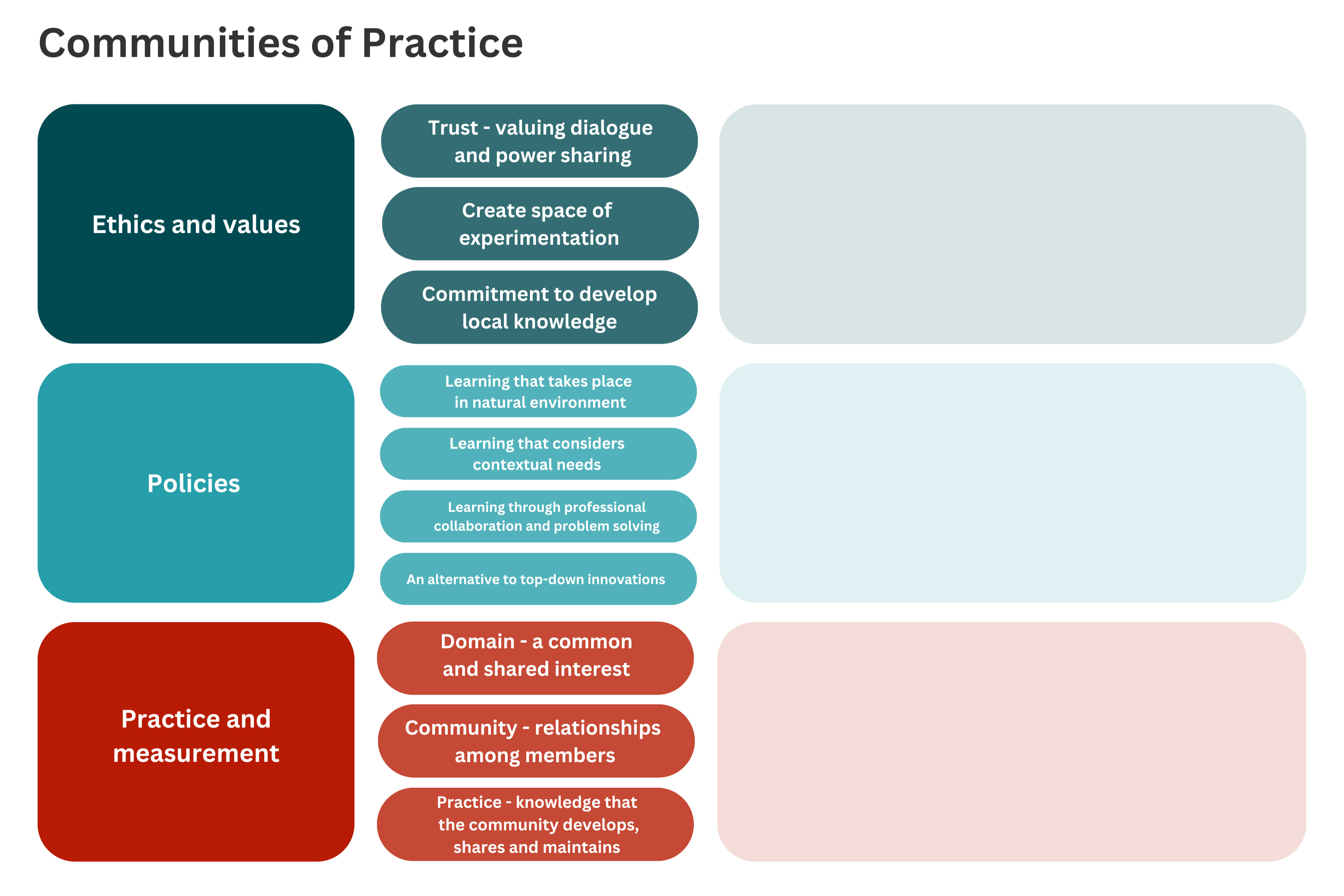

After completing the introduction, you will know more about
the theoretical background of the four key concepts, and
how these key concepts are defined and used in the I CO-COPE context.
Theoretical background
Building on a solid theoretical basis is crucial to establish a shared understanding of the four key concepts.
Due to the diversity of perspectives and historical and contextual variations, we adopted a multidimensional approach to defining the four key concepts.
In other words, there is a description of each key concept along three dimensions:
ethics and values
policies
practice
The four key concepts
The aim of this introduction is to build a common base of knowledge on the following four key concepts in the I CO-COPE context.
-
Inclusive education
-
Interprofessional collaboration
-
Students' agency
-
Community of Practice
-
Click on the buttons to learn more about the four key concepts along the three dimensions.
-
Read more
Inclusive education
Find out more about what is meant by inclusive education and explore it along the three dimensions.
-
Read more
Interprofessional collaboration
Find out more about how interprofessional collaboration promotes inclusion and innovation in education through shared ethics, supportive policies, and practical engagement.
-
Read more
Students’ agency
Find out more about how to collaborate with students in a participatory way to promote their empowerment and co-creation for inclusion and innovation in education.
-
Read more
Communities of Practice
Find out more about how Communities of Practice are embedded in ethics and values, policies and practices, and how this approach can be used to foster and strengthen inclusive…
The four key concepts in the context of the I CO-COPE project
In the following section we provide a brief overview of how we define the four key concepts in the I CO-COPE project, and how we understand and use the relevant terminology in this context.
-
Click on a key concept to expand and collapse the information related to that key concept.
Inclusive education
An inclusive educational system ensures equal participation for all children and young people, it respects and recognises the diversity of all students and fosters a sense of belonging. In the I CO-COPE context, we see inclusion in education is a dynamic process that enhances participation in learning, culture, and community while reducing barriers to education. Unlike integration, which expects learners to adapt to the existing system, inclusion in education requires adapting content, methods, and structures and relies on collaboration among professionals, families, students, and the wider community to create a supportive learning environment for all (Ainscow et al., 2006; UNESCO, 2005). The I CO-COPE project explores ways to support secondary schools in their inclusive school development through the Communities of Practice (CoP) approach.
Click here to see a visualisation of the differences between integration and inclusion in education.
Interprofessional collaboration
In the I CO-COPE context, we follow Borg and Drange (2019, p.252) and understand interprofessional collaboration as joint interprofessional efforts in teams to achieve mutually desired outcomes through shared decision-making. We distinguish between “interprofessional” and “interdisciplinary”. While interdisciplinary collaboration happens between experts with the same profession but from different disciplines, fields or or classes (e. g. different class teachers or subject teachers, special needs teachers and mainstream teachers etc.), interprofessional collaboration happens between experts of different professional groups.
Click here to see a visualisation of the difference between interprofessional collaboration and interdisciplinary collaboration.
So, in our understanding interprofessional teams in secondary schools consist of representatives of different professions and groups, like for example the principal, members of the school board, class teachers, students, their families, teachers for inclusive education, teaching and learning assistants, social workers, school psychologists, therapeutic professionals, etc.
Mutually desired outcomes regarding the promotion of inclusion and the improvement of the well-being at school can be the enhancement of the quality of education for all students as well as solutions for specific challenges of individual students. The I CO-COPE project focusses on the Communities of Practice (CoP) methodology to achieve these outcomes.
Click here to see a visualisation of the definition of interprofessional collaboration through Communities of Practice.
Student's agency
Students' agency refers to their ability to take an active role in their own learning, make choices, and influence their educational experiences. It involves empowering students to set goals, make decisions, and engage in critical thinking and problem-solving. Students’ agency is fostered through a supportive environment that values student voice and autonomy and encourages co-creation and participation in shaping their learning journey and well-being at school. In the I CO-COPE project, students are actively involved in Community of Practice, to give them a voice and ensure their equal participation in (inclusive) school developmental processes.
Communities of Practice
In the I CO-COPE context, we embrace Communities of Practice as a group of people who share a passion or a concern and deepen their knowledge by interacting about it on an ongoing basis.
In contrast to traditional models of learning, which are based on a dialogue between experts and non-experts, Communities of Practice imply learning as a transformative process, in which all participants are on an equal footing, bring their expertise and different, valuable perspectives, and as a result learn from each other and collaborate in a participatory way.
There are three main elements in a Community of Practice (Wenger & Wenger-Trayner, 2015):
DOMAIN means to consider a particular context and goal that drives the community
COMMUNITY is about sharing ideas and mutual engagement to find solutions in a participatory way
PRACTICE means to create new knowledge that is transferred into the needed intervention
Click here to see a visualisation of the three main elements of Communities of Practice.
Reflection task
-
You have learned a lot about the four key concepts now and how we understand them in the context of I CO-COPE. We invite you to relate the newly gained knowledge to your personal experience.
Click below to download a table with the three dimensions for each key concept. Write down an example from your own experience for each of them. Start with your own definition of the respective key concepts.
The second download file contains examples and impressions collected in different schools which collaborate in the I CO-COPE project.
Additional resources
Silveira-Maia, M., Neto, C., Sanches-Ferreira, M., Alves, S., Durães, H., Breyer, C., Vandenbussche, E., Boonen, H., Zacharová, Z., Ferková, Š., Schukoff, P., Unterreiner, S., & Teijsen, E. (2025). Mapping CoP for inclusion: a Knowledge Base. Instituto Politécnico do Porto. https://doi.org/10.26537/e.ipp.136